
The Rundown: Some Surprised Cabrera Cleared Medicals, Phillies Meeting with Bichette, Manfred Has Discussed Huge Schedule Changes

Lost in all the arbitration hoopla yesterday was a subtle indication that the Cubs may be taking a slightly different tack with spending than what we’ve seen in the past. Or maybe it’s more of a return to what we saw when Theo Epstein was running things. Epstein and Jed Hoyer had a reputation for never going to the arbitration table with eligible players, thus avoiding the risk of having to sit down and explain to said player why he’s not worth the money he asked for.
It’s an acrimonious process that can lead to bruised egos and eroding trust, something we saw with Corbin Burnes in Milwaukee a few years back. It wasn’t until Justin Grimm made the questionable decision to push back on the Cubs’ number that Epstoyer had to see the process to its conclusion. Grimm predictably lost his case and the Cubs have since had several more instances in which they didn’t settle with players ahead of the initial deadline to do so.
The most recent of those was with Kyle Tucker, who was still getting used to his new situation following the big trade that brought him to Chicago. Though the two sides eventually settled on a $16.5 million salary without the need for arbitration, the Cubs being $2.5 million shy of Tucker’s initial ask didn’t set a particularly rosy precedent. Projections had him getting around $16 million, with Tucker asking for $17.5 million and the Cubs filing at $15 million.
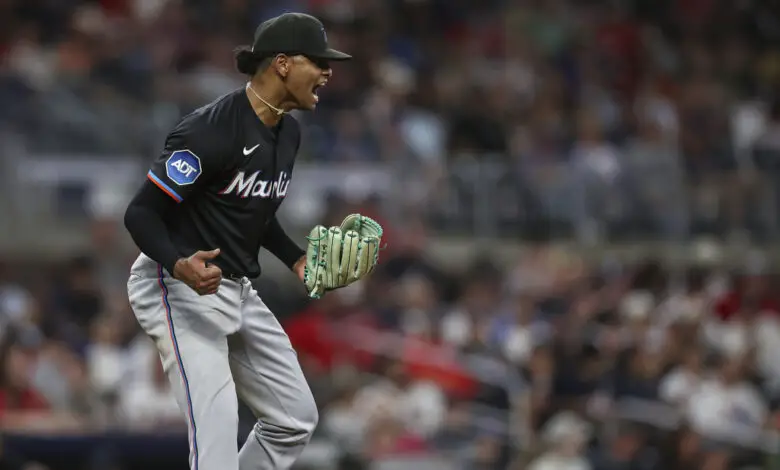
With that in mind, it seemed entirely likely that the Cubs might try to lowball Edward Cabrera just a day after acquiring him in yet another buzzy swap. Instead, the two sides agreed to a $4.45 million salary that came in about $750,000 above MLB Trade Rumors’ projection. Justin Steele likewise got more than his projected figure, coming in at $225K above. Javier Assad was slightly under, but $100K isn’t egregious.
Even with the understanding that Hoyer managed to save at least $16 million in AAV by trading for Cabrera rather than signing one of the top remaining free agent pitchers, this soft splurge of nearly $900,000 could indicate that there’s a little more in the budget than expected. Either that, or we can most definitely stop wondering about whether the Cubs will target any of the big bats still on the market.
Cabrera’s Medicals Scared Some Teams Away
A lot of people are understandably cautious about the Edward Cabrera deal, whether it’s his spotty health history or the fact that they expected Owen Caissie to be the next Matt Murton. There are some who question Cabrera’s track record of not *checks notes* filling Miami’s stadium and singlehandedly taking the Marlins to the playoffs as the ace. But even the most optimistic among us have to acknowledge the fact that betting big on a guy with 11 trips to the IL in his career is a little scary.
“I’ve poked around a lot on this trade, and the big thing that jumps out to me is how little talk there’s been that Cabrera sprained his UCL at the end of last season,” Marquee’s Lance Brozdowski told Foul Territory. “And I understand he came back at the end of September, I believe, and threw two times. But this is something from my understanding in talking to people in the league, and talking to teams who communicated with the Marlins about Cabrera, this was a hangup for other teams.”
“I think if you gave these medicals to 30 teams in baseball, I don’t know entirely how many of them would have approved them. The Cubs approved them, and the Cubs are very sharp on the medical side…I’ve talked to people in the league who were kind of surprised that he cleared medicals.”
Of course, Matthew Boyd hadn’t even pitched 80 innings in any season since 2019 before logging almost 180 for the Cubs last season. Steele struggled to stay active during his time in the minors, even undergoing elbow reconstruction in 2017, though he might not be the best example to use. Cade Horton is another Tommy John survivor who pitched very little in college before missing most of 2024 with shoulder issues, then he threw more innings last year than at any point in his life.
The fact that Cabrera has never required surgery is either a mark in his favor or a red flag that a long absence is inevitable. After all, nearly 40% of all MLB pitchers used last season had already undergone TJ surgery, not to mention any number of other procedures. Hoyer wasn’t being reckless, but this isn’t the kind of move he’d have made for just anyone.
Brozdowski noted that the Cubs were obviously comfortable with what they saw, both due to Cabrera’s elite stuff and the fact that he’s not a rental. This is the kind of risk/reward move many of us have been waiting for Hoyer to make for years now on the pitching side. The Cubs have been overly conservative, rarely seeking out pitchers with big upsides in favor of dudes who throw 93 and pitch to contact. Cabrera is a rare reach who gives them a decidedly different look in the rotation.
“This dude can be a frontline starter,” Brozdowski said. “He’s incredibly exciting for the Cubs to add to the rotation.”
Bichette Said to Prefer Philly
As talk has turned to the Cubs’ need to add a big bat, Bo Bichette has emerged as a likely target. Not only have the Cubs shown interest, but the thought is that his price will be lower than other options on the market. The team seemed to have soured on Tucker for reasons other than just money during the 2025 season, and he’s going to command the kind of long-term contract the Cubs won’t want to do. Cody Bellinger has gotten at least two formal offers from the Yankees, the latest of which reportedly exceeds $30 million AAV.
Right-handed batters are a better fit at this point, and Alex Bregman could well be headed back to the Red Sox if reports of their aggressive offer are close to accurate. Bichette seems like the guy who could be left without a chair when the music stops, especially with questions about his defensive role and acumen. That could have him settling for a contract that allows him to prove his worth with a chance to hit free agency again ahead of his age-30 season.
Multiple reports have confirmed that Bichette has a virtual meeting with the Phillies scheduled for Monday. According to Bob Nightengale, Bichette expressed a desire to play for the Phillies after they hired Don Mattingly as their bench coach. Philly would probably have to stop talks with J.T. Realmuto and trade Alec Bohm, who just agreed to a $10.2 million salary, to accommodate Bichette on a reasonable deal. But with his ask reportedly reaching $300 million, is his familiarity with Mattingly from three seasons as Toronto’s bench coach enough to negotiate that number down?
It doesn’t really need to be, as no team is going to pay anywhere near that figure for a guy with limited power and a suspect glove. Still, it would seem as though the Phils might have a built-in advantage over the Cubs and other interested teams. We also know that Phillies baseball boss Dave Dombrowski is no stranger to spending owner John Middleton’s money, even if Nightengale noted Phillies execs as saying a deal is unlikely.
Let’s just say this is a way for Bichette’s reps at VaynerSports to drum up a little more interest from the Cubs, Dodgers, and other suitors. What, then, would a deal have to look like to get him to Chicago? Roster Resource has the Cubs at a little over $213 million in CBT payroll right now, giving them under $31 million left before hitting the first penalty threshold. If we subscribe to the notion that Hoyer has a little more in the budget than expected, and knowing that a ton of money is falling off in 2027, Tom Ricketts might let him spend past the first level.
Even so, I don’t think we’d see the Cubs entertaining a deal of $30 million AAV for more than four years. Maybe something like three years and $85 million with an opt-out after the second year. If they do a $10 million signing bonus with the first year at $25 million, the second at $35 million, and the third at $15 million, Bichette could get $35 million AAV and go back on the market at 30 years old. Or maybe it’s four years and something from $105-120 million with a similar front-loaded structure.
I still think it’s more likely the Cubs end up settling for a lower-profile solution, but it’s fun to discuss.
More News and Notes
- Tarik Skubal filed at $32 million and the Tigers came in at $19 million, making it the largest gap in arbitration filing history. Should the perennial Cy Young contender win, he’d surpass Juan Soto‘s $31 million arb salary as the highest ever.
- The largest arb salary for a pitcher is $19.75 million, set by David Price many moons ago. Skubal will definitely beat that.
- The next-largest gap between player and team was William Contreras, whose $9.95 million filing was $1.35 million higher than the Brewers’ figure.
- MLB commissioner Rob Manfred told WFAN that he has had conversations about a split season with a mid-season tournament. This isn’t the NBA, my dude.
- All nine teams with FanDuel Sports Network broadcasting agreements have terminated their contracts, per Evan Drellich of The Athletic, paving the way for MLB to take over more rights. The Angels, Braves, Brewers, Cardinals, Marlins, Rays, Reds, Royals, and Tigers are the teams impacted.
- New Cubs reliever Hunter Harvey told Foul Territory that he chose the Cubs largely to work with Tyler Zombro and the rest of their pitching infrastructure. The flamethrowing righty believes the Zombro can help him stay healthy and perform at his best.
Where MLB Players Were Born
Baseball Savant creator Devin Wilman put together this animated map that shows where every MLB player was born between the years of 1832 and 2005. This is mesmerizing.
Ahead of the @WBCBaseball, I put together a map of where every @MLB player was born from 1832–2005. Pretty cool to watch and see how the the game has grown ?⚾️ pic.twitter.com/8UY5mpNWhV
— Daren Willman (@darenw) January 8, 2026


