
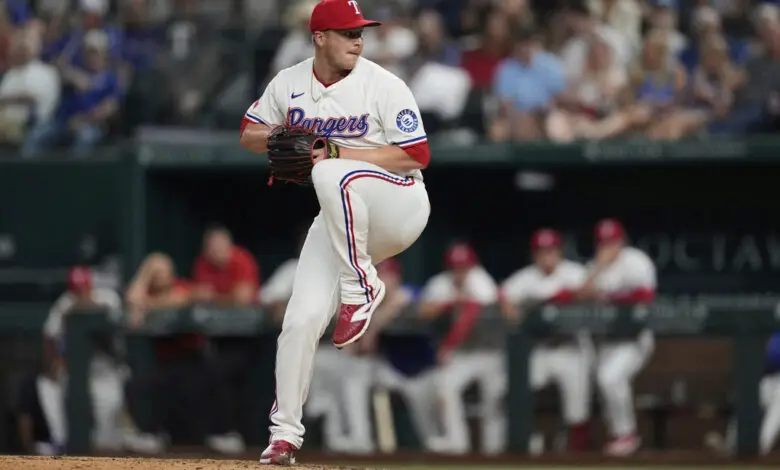
Jacob Webb Looks Like Interesting Project for Tommy Hottovy, Tyler Zombro

I said I was going to take a short break unless something important came up, which this is not. It is, however, something I found interesting enough to put a pin in for later. Twitter user David Kep drew my attention to a thread from Matthew Knauer of Daily Bruin Sports, who highlighted two potential unlocks for reliever Jacob Webb back when he was non-tendered by the Rangers. And wouldn’t you know it, both are hallmarks of the Cubs’ pitching infrastructure.
Webb has thrived in spite of his pedestrian fastball velocity, mainly because he pairs exceptional ride with a what Knauer calls a “lifty” changeup. He gets enough separation between the 93.4 mph four-seam and 84.9 mph change that he hasn’t needed traditional depth from his offspeed. Ah, but finding a way to sort of fake that vertical differentiation might take his game to a new level.
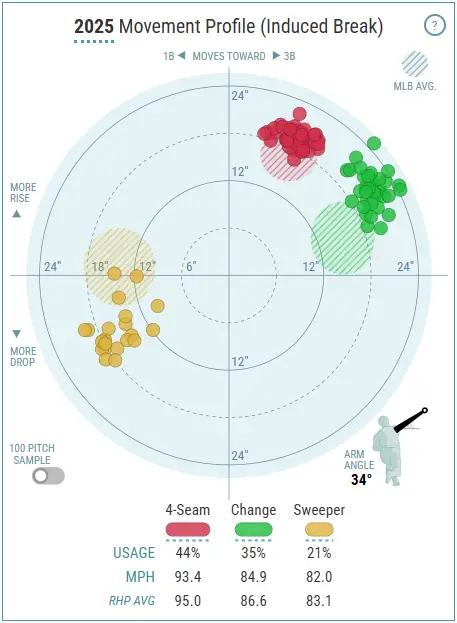
Knauer pointed out that Webb’s average fastball height of 2.82 feet was in the 39th percentile, and that his two-strike fastball height of 2.96 feet is in just the 27th percentile. Elevating the heater will not only make it a little more difficult to hit, but it will also create a little more separation from the change. Under pitching coach Tommy Hottovy, the Cubs have prioritized working higher in the zone with fastballs, even sinkers.
That was a major focus with Shōta Imanaga, who also possesses a high-ride fastball that he used to locate lower due to NPB’s adjudication of the zone. The lefty did a better job of working higher in his first season, but the four-seam was thrown almost a full tick slower with just over an inch more drop in 2025. It also had a bit more arm-side run. The result was a four-seamer that went from the 68th percentile in run value to the 10th, leaving Imanaga unpitchable late in the postseason.
His breaking and offspeed offerings were still outstanding, so figuring out how to get the fastball working again could yield a return to his earlier form. He and the Cubs say the issue has been identified, and Imanaga has been working with the folks at Cressey Sports Performance to ensure he comes back stronger in 2026.
Back to Webb and the second key to even better performance moving forward, which is a sweeper that has gotten poor results due to the way its shape differs from his other pitches. It’s a very unique pitch because he’s able to get serious two-plane movement despite being a pronator, but it’s so different from his fastball and change that hitters can spit on it. As Knauer noted, it generates a swing rate of under 40% with a whiff rate of just 22% and a decided lack of chase.
Shifting to either a gyro slider that more closely mimics the shape of his other pitches or adjusting the slurvy sweeper to reduce its horizontal movement could combat what looks like strong potential for regression. That is where new pitching VP Tyler Zombro comes in handy, as he’s an expert in tailoring pitchers’ arsenals to their pronation/supination biases. As you can see in the video below, Zombro would typically recommend a gyro slider for a three-quarter-slot pronator like Webb.
Are you throwing the best pitches for your arm slot? ?
Performance Specialist @T_Zombro24 breaks down which pitches you should throw depending on your arm slot and release bias. ✍️ pic.twitter.com/Yb8Rc9d7wy
— Tread Athletics (@TreadHQ) December 19, 2024
The Rangers have been a little myopic when it comes to pitching development, to the point that they shy away from aerial movers and guys whose extension falls below a certain threshold. And while there is something to be said for finding a type, like the Cubs with guys who throw cutty fastballs, automatically ruling a significant portion of the pitching population out on principle leaves you with less margin for error.
With Webb, the Rangers saw a 32-year-old reliever with below-average velocity who was projected to earn around $2 million via arbitration. That’s the same amount he can earn with the Cubs if he maxes out incentives on top of his $1.5 million guarantee. Given the disparity between his 2.99 career ERA and 4.07 FIP — those numbers were 3.00 and 4.30 last season — the Rangers were apparently willing to move on rather than tinker. Their loss could be the Cubs’ gain if Webb is able to tweak his approach and arsenal on the North Side.
It’ll be at least two and a half more months before we can see Webb in action to know whether he is indeed making any of the changes noted here, but maybe we’ll get some reporting on it between now and spring training. This is definitely something I’ll be keeping an eye on moving forward.


