Long Work Stoppage in 2027 May Not Be as Imminent as You Think

I loved Aesop’s Fables as a kid, and many of those delightful truisms still apply to everyday life. In fact, the story of the goose that laid the golden egg aptly defines the current economics of baseball. You’re at least familiar with the story in layman’s terms, even if you are unaware of Aesop’s work. To wit, a poor farmer owned a goose that miraculously laid a golden egg every morning, and he and his wife became rich selling those eggs. Soon, one per day wasn’t enough. The greedy farmer, believing that the bird’s insides were filled with gold, killed the goose and was left with nothing. He and his wife ended up poorer than they were before the wealth-providing waterfowl started enriching their lives.
The moral is obvious: Beware of shortsighted greed.
That is one way of explaining the excess of the Los Angeles Dodgers, who on Tuesday picked up where they left off last winter by signing closer Edwin Díaz to a three-year $69 million contract. The Dodgers are determined to have the best player in baseball at every position in their everyday lineup, and Díaz is expected to alleviate the single weakness that almost cost them the 2025 World Series. It was a savvy move by an organization that truly prefers championships over bottom lines, a rarity in the current iteration of America’s pastime. Further, the Dodgers’ front office continues to piss up the legs of analytic terms like regression to the mean and dollar values per win. You might say they’re treating the ghosts of Branch Rickey and Buzzie Bavasi the same way. Bavasi had so much homegrown talent in 1954 that he couldn’t keep Roberto Clemente.
The Dodgers, they say, will push baseball into its first significant work stoppage since 1994. I don’t believe that’s what’s coming, and though an impasse is inevitable, I’d bet it will feel much more like that mosquito bite that postponed two weeks of the 2021 season. Baseball is coming off its most popular World Series since 2016, one that truly put the league on a global stage thanks to the likes of Shohei Ohtani, Yoshinobu Yamamoto, and Vladimir Guerrero Jr. The seven-game series averaged 51 million viewers per game across the U.S., Canada, and Japan.
Baseball’s current CBA expires in one year, and a salary cap or floor is bound to drive a wedge in negotiations between the owners and players. That said, no sport defines parity the way MLB does. The Brewers had the best record in baseball with only 20% of the financial commitments the Dodgers had. The Mets missed the playoffs despite committing over $400 million in salary and luxury tax penalties to their roster. They lost out to the Reds, who reside in baseball’s 11th-smallest market. New York has just one championship since 1979, which gives that organization the same bragging rights as the lowly Pirates.
Will a cap help? I don’t see the Pirates, Marlins, White Sox, Rays, or Rockies committing to annual payrolls of $250-300 million just because a cap is in place. What about a floor? The NHL has a floor and it hurts the sport. A mandated minimum creates artificial payrolls, distorts the market, and won’t improve competitive balance. That is the NHL in a nutshell: Applying a chokehold to a free enterprise system encourages leaguewide mediocrity. That’s not the same as parity, even if sports franchise owners want you to believe it is.
Baseball has bigger fish to fry, in my opinion. The gambling problem that brushed up against Ohtani could end the careers of Emmanuel Clase and Luis Ortíz. Pitching injuries are rampant. Lack of diversity hurts the sport, too. Tanking is a big issue, and the draft lottery is not the panacea everyone expected. Most teams, with the exception of the Yankees and Dodgers, need to get out of their local television deals. The layoffs at Marquee Sports Network are regrettable and represent the general failure of most regional sports networks. There is also the issue of deferred contracts, something the Dodgers have leveraged to win back-to-back championships. You may disagree with that type of financial flexing, but the Dodgers are good for baseball and they’re not breaking any rules.
A cap or floor is going to be a non-starter in CBA negotiations because the MLBPA will die on that hill. They’ll reject any language in the next proposal that looks, sounds, or smells like it will restrict salaries. Sure, what’s going on in Los Angeles will raise the stakes a bit, especially if they sign Kyle Tucker. I’ve heard players are willing to sit out indefinitely in opposition to a cap, though I’d assume they’d give in if a second season was at risk. The owners don’t want that, though. They also don’t need a centuries-old fable to remind them of the downside of killing the golden goose. The league barely recovered in 1994, and would have died without Mark McGwire, Sammy Sosa, and Ken Griffey Jr. There are too many entertainment options today to count on a similar amelioration.
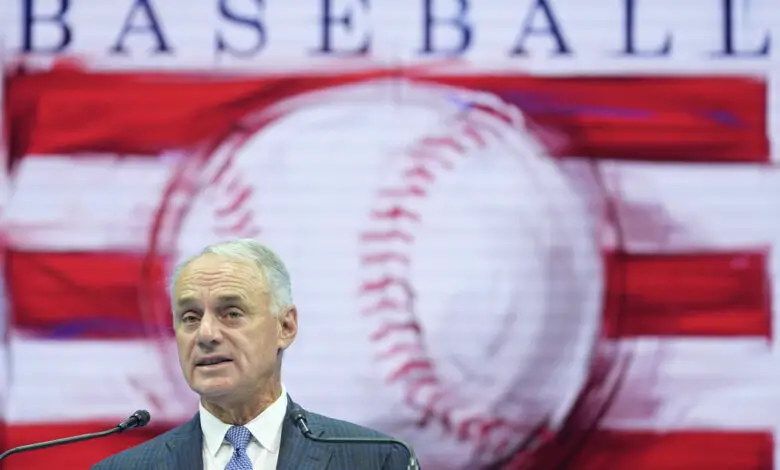
The 2026-27 negotiations will likely be the last with Rob Manfred serving as commissioner. Manfred is indirectly responsible for the game’s resurgence in this post-pandemic landscape. The fruit of his labor is the forward momentum that the sport currently enjoys. Attendance grew for the third straight season, and World Series viewership was up 19% over 2024. Manfred won’t want a work stoppage to blemish his tenure, despite what he’s previously said ($) about a potential lockout. He has a perfect record in that respect: No missed games because of labor issues, and no missed broadcasts despite upheaval in the media industry.
Tony Clark, who has survived despite his tumultuous record as the MLBPA’s executive director, deserves credit as well. That said, he will not acquiesce on a cap or floor, even if it enables some form of doomsday scenario.
“I’m not going to negotiate through the media, but I will tell you this,” Clark said before the World Series. “The issues that we see in the system we know can be addressed without [a salary cap].”
That may mean a concession from both sides with respect to contract deferrals. Clark wants to protect that, too, but he’s got a wealth-building goose of his own to safeguard. Considering the freedoms provided by the Internal Revenue Code for unqualified deferred compensation contracts, other teams might benefit from emulating the Dodgers’ strategy. Why don’t they? To govern salaries, of course. It’s not collusory by any means, but it’s a hivemind strategy nonetheless. Still, I think you’re going to see a little more financial exuberance in this year’s free agent market. That seems to be the norm in the penultimate year of each CBA. It also hides any stench of potentially gaming the game.
You may even see other front offices opening up to deferrals. The Pirates reportedly offered Kyle Schwarber $120 million before he reupped with the Phillies. One would think deferrals would be enticing to a small-market team willing to increase its payroll by 20-25% with the addition of one player. Then again, the Pirates collect a tidy annual profit thanks to baseball’s poor competitive balance rules.
Clark was surprised by Ohtani’s decision three years ago to defer $680 million of his $700 million contract, but never questioned it. Under the current CBA, no deferral restrictions exist. According to Clark, that is a right the union is determined to protect. So far, the Dodgers are the only team willing to push that envelope. They’re not going to stop unless somebody tackles them, either.
That may be the solution to any impasse driven by the suggestion of a cap or floor. Still, it’s difficult to say the league has a competitive balance problem (see Pirates, above). Challenges will exist and it may be mid-March before we light the 2027 season’s hot stove. That delay might actually play right into Manfred’s hands. The esteemed commissioner would love nothing more than a free agency free-for-all within a limited window. Manfred would also prefer to align it with baseball’s annual Winter Meetings. Clark, of course, wants nothing to do with that. Then again, concessions have to come somewhere from both sides.
How will it all play out? I think we’ll see a limit on deferrals and a hard stop to the free agency signing period, but a cap and/or floor is not in the cards. As much as I hate to say it, Manfred will retire as the greatest among baseball’s 10 commissioners going back to Kennesaw Mountain Landis. That also means Wrigley Field will still host the 2027 All-Star Game and all of its associated pageantry.